My first day in France was marked by croissants, posters of the visiting Pope, and the largest student protest in nearly 50 years. Sitting in a Parisian café, you could continually hear the whirring of helicopters and sirens—although half the time there’s confusion over whether it’s for the Pope or protestors.

With over 266,000 protestors out on the streets, where do student unions fit into this picture?
Before getting to that, I’d like to dig into why student protestors are out on the streets in the first place.
“For the young people, this is a crisis of hope.” This is according to Andrew Smith, historian of modern France and lecturer in Liberal Arts at Queen Mary University of London. “You can see they are bombarded daily with economic problems, political extremes, dangers of warfare in Europe, the threat to their careers from AI, high youth unemployment rates, the climate crisis.”
When you ask students, many of them are fed up. This past summer, hundreds of thousands of students roasted in over 40 degree run-down, overcrowded classrooms. But besides dilapidated school infrastructure, students are also fed up with the lack of meaningful engagement between the government and student unions in recent years—a hallmark of indifference, some say, of the current French government.

Chloe Grunenwald is the Vice President of Social Innovation at the Federation of the General Association of Students (FAGE), the largest organisation of its kind in France, representing over 300,000 students. “This is too much. Enough is enough. We have been making these demands for years. We need more money for education, we need more teachers, we need better facilities”.
Student unions have since published a list of 10 demands estimated at 10 billion euros ($15.9 billion CAD), and have vowed to maintain the pressure until all their basic requirements are met. Among the demands are calls for stronger investment in schools and universities, as well as much needed support staff and space in higher education. Students are also calling for better housing and financial support, affordable university meals, and an end to inflated tuition fees for international students. The final demand calls for an end to “all forms of repression linked to the high school and student movement”.
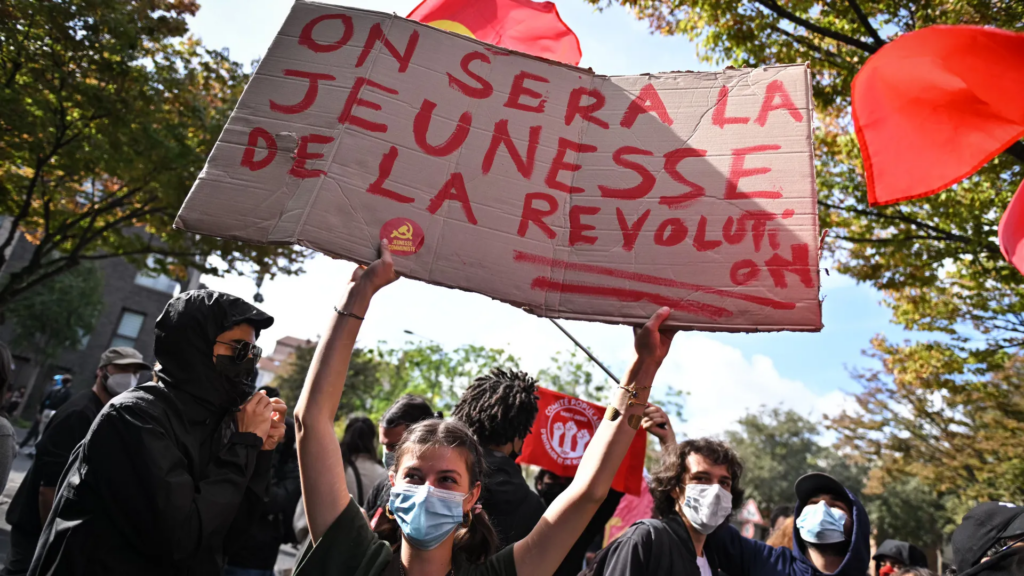
The international headlines so far have focused heavily on this last point, namely the violence.
French Prime Minister Sébastien Lecornu has described these protests as “the most violent in decades”, with human rightsgroups, including Amnesty International, denouncing French police response for use of excessive force and brutality.
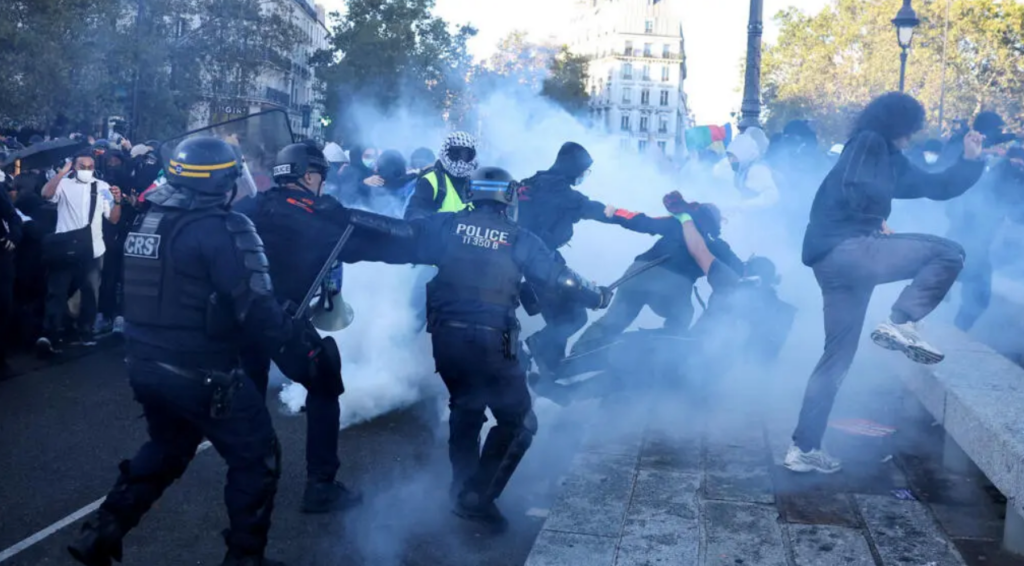
Since last Saturday, 24 investigations have been launched by French police watchdog IGPN into incidents of policy brutality, including a 14 year old boy who suffered a broken jaw and smashed teeth after being shot in the mouth by a police officer, a 16 year old teen who was shot left eye by police with rubber bullets, and a 15 year old kid who had his hand blown off by an officer’s stun grenade. These incidents have been so horrific and politically damaging that quickly prompted French interior minister Laurent Nunez to pause the use of stun grenades pending an investigation.
So far 6,877 people, mostly minors, have been arrested, but that has not deterred the student movement in France. Nationwide strikes and anti-government demonstrations are scheduled for this weekend (17 October), and are expected to bring together a significant number of unions to amplify their grievances against soaring food costs and energy prices, proposed budget cuts, and freezes on public sector salaries. According to Alice Cohen-Morzadec, international spokesperson for France’s Student Union, “We are going to mobilise until we get our demands, especially because we have October 17 and November 20 – as an international date for the youth in all Europe to mobilise for our future, so we want to continue at least until those dates, if not further”.
In my takeaway, many of the issues that French students are facing resonate with the Canadian experience: underfunded institutions, extremely high international student fees, lack of education spaces and supports, and perceived government indifference to student issues. But whereas French student unions are mass mobilizing across the country (in the hundreds of thousands), Canadian ones have been relatively isolated and limited in their mobilization efforts, or tend to rely heavily on traditional methods of advocacy (e.g. in-person meetings with politicians). The scale of mobilization, coordination, and unity that French student unions are displaying is something I think that Canadian student unions could (and should) learn a great deal from.