

Allure of the Arena
Higher education institutions, namely universities and colleges, are seen in a variety of different lights depending on who you ask.
For students, they are the hallowed halls of knowledge and the abodes of the intellectual elite. They can provide a seemingly surefire way to attaining a better quality of life, while also providing a chance to explore oneself and the world in a safer and more forgivable manner.
For employees, more specifically the academic staff, otherwise known as faculty members; they are the ivory towers from which beacons of light (i.e. themselves) shine out to illuminate the world for the rest of society. Admission into these quasi-sacred spaces as an academic employee offers the opportunity of a lifetime: the ability to indulge one’s curiosity of interest, all the while being protected from recourse and being substantially compensated.
For administrators, the employees who manage and steer the direction of the institutions, they are increasingly complicated and multi-dimensional machines; that are both integral to society, and yet not bound by their standard conventions. Due to this unique standing, promotion to the administrative ranks of these institutions are highly coveted. They allow one to unlock nearly every door on every floor of society, all the while being lavishly rewarded.
With such differing perspectives at play, the challenge becomes ensuring that mechanisms are in place so each faction has enough of the bread broken to appease them.
Enter the collegium.
Crystallization of the Colosseum
One can go their entire career in higher education institutions and not be aware, nor care, about the intricacies that are required to run them, much less their existence at all!
However, for those that are interested to have a look under the hood of higher education governance, we must first understand the concept of collegial governance. Simply put, collegial governance is the concept of needing to come to administrative decisions collectively.
Within higher education circles, and particularly at research oriented institutions like universities, bodies like these are mandated standards world-wide. In the Canadian context specifically, this is usually established through government legislation in the form of a federated bi-cameral system. This means that governance is done with two decision-making bodies: a Board and a Senate.
The Board is similar to a corporate board in that they are the final decision makers of the organization. They have oversight over strategy and particularly finances. The Senate, however, is a body unique to higher education institutions. While the Board has the final say, in many ways, the Senate decides what the Board has the final say about. Senates control the academic related decisions of the institution before they go to the Board for deliberation.
This federation is integral to ensuring that the core mission of education and research is delivered upon. Sadly however, theory and practice can become more oil and water than salt and pepper. Especially if those who are affected by them choose not to use them.
The Right to Fight
This brings us to the dilemma in modern higher education governance. While faculty members have had centuries of organizing in such spaces to ensure their academic freedom, students by and large have not had such a concept formulated for them. I believe the biggest impediment to this is because of the machinations of the employees of these institutions, namely the administrators and by extension their supporting staff as well as faculty. This is also echoed in the testimony of the institutions’ consultant class. All of this occurs despite students formally having seats on such decision making bodies, as recommended since 1966 with the Duff-Berdahl report. In effect, the most vulnerable voices have been strategically undermined to be kept the quietest.
Collegial Governance as a concept cannot include students as they are not colleagues (fellow academic employees) to faculty members and administrators (who retain their status as academic employees when in managerial positions). Seeing such disparity between what is idealized and what is actualized with regards to respect for students’ opinions, I coined a new term: Novial Governance.
Seeing the etymology and conjugation of the word ‘Collegial’ (from Old French collegial or late Latin collegialis, from collegium ‘partnership’) I followed the same path with the word ‘Novice’ (from Old French novice, from late Latin novicius, from novus ‘new’) to reach ‘Novial’. The word ‘Novice’ was chosen as I felt its modern definition best fit as a synonym for ‘student’, while also having the same suffix ‘e’ in the modern root form of ‘Collegial’ i.e. ‘Colleague’. I believe that keeping the suffixes similar would help to evoke the same understanding of respect between the two phenomena, despite coming from two different constituencies.
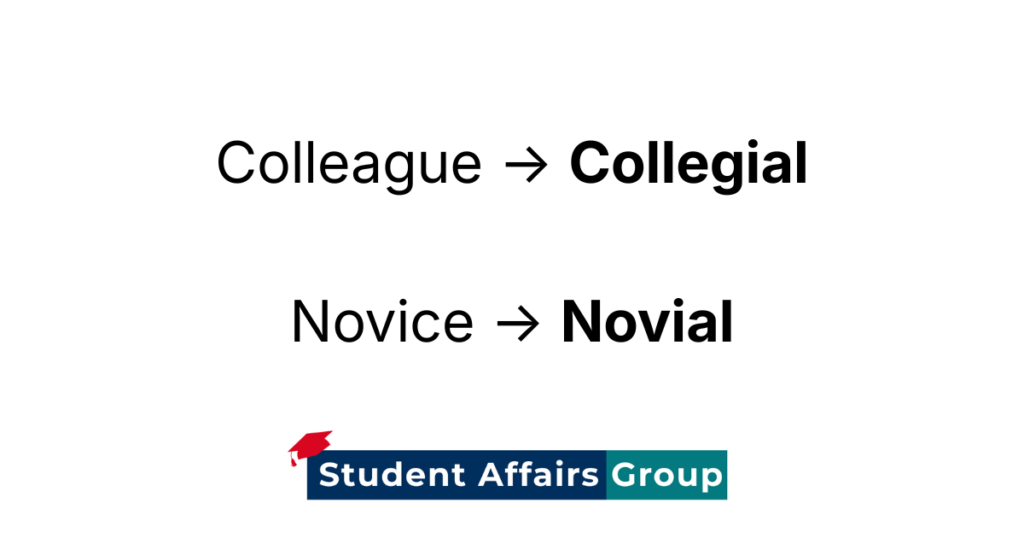
With this phenomena better qualified, both terms can be understood to now describe different needs and experiences. Consequently, another term must be used to qualify these two phenomena together. For this, an appropriate term would be community governance.

As higher education institutions grow increasingly complex, more governance bodies are also required to maintain their operations. Just as Collegial Governance should not be forgotten in these new spaces, Novial Governance must be accepted in all spaces so students are not left out of decision-making bodies that are core to their education. Just as faculty are there to teach and provide employment connections (more so in college settings), or provide meaningful research (more so in university settings), students are there to learn and become employable (both in college settings and university settings). Those are the core outcomes of all higher education institutions within Canada, and is the founding ethos for why the vast majority of the most prominent ones are publicly founded (though autonomously governed) and substantially publicly financed. In other words, these are public institutions founded to produce public goods to the benefit of society in the form of novel insights (research) and skilled workers (graduates). Not respecting the opinions of those who will eventually become the backbone of the nation’s most influential industries, risks investing more resources on diminishing human capital.
The best way to ensure we are getting the best bang for our bucks is two fold:
1. Students (and particularly their leaders at: CFS, CASA, UCRU, and everyone else underneath and inbetween) have to collaboratively organize their resources to create an ecosystem that fosters student governance research. At the end of the day, students are the ones that are losing the most, and inversely they are also the ones with the most to gain.
2. Non-student supporters must be willing to support student governance initiatives in independent and safe ways. Students must be allowed the independence to make their own decisions, while also having the learned advice to temper their fervour, and safety net to rebound them when they fall. If students are not allowed independence their actions will not be as potent, or worse be exploited. If students don’t have learned advice their initiatives will continually burn out short term. If students don’t have a safety-net, they are likely to suffer grievous and sadly even fatal harm.
The featured image is designed by pikisuperstar / Freepik.


