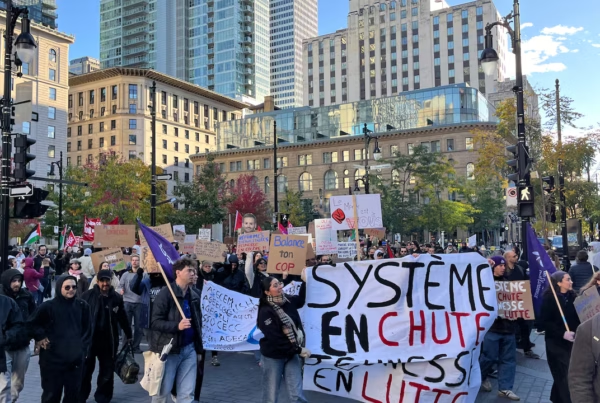
Last month, thousands of students across the province marched in opposition to the Ford government’s looming 60 percent cuts to student aid. The Ontario Student Assistance Program (OSAP) provides a mix of non-repayable grants and repayable loans for low- and middle-income students to access higher education, providing a vital lifeline for half a million students each year. These latest changes will slash the maximum OSAP grants awarded from 85% to 25% by Fall 2026, severely shifting Ontario’s student financial aid towards a loans-based system.
Here are three myths that Doug Ford’s government has been pushing about students to justify these changes:
1. “They’re misusing OSAP funds”
When asked about why he initiated OSAP grant cuts, Ontario Minister of Colleges and Universities Nolan Quinn claimed that “you can go onto social media and you can see some of the stories that are there of students using their OSAP funds for other priorities”, but when pressed further, could not provide any concrete details. Rather than back up these allegations of misconduct with evidence, Minister Quinn’s office has since provided social media links to TikTok videos on posts claiming OSAP misuse. Previously, the Ontario government stated that it had investigated dozens of alleged OSAP misuse by students, but according to an official ministry spokesperson they could not provide any information on the outcome of these investigations.
Unfortunately for Doug Ford and his government, their claims do not align with factual evidence. OSAP requires strict documentation (i.e. tuition levels, financial means, academic performance levels), as well as annual re-application periods, in order for students to qualify for funding. Depending on a students’ assessed need, students are provided a mix of grants to loans, the latter of which they’re required to repay within just 6 months of graduating.
According to the government’s latest data for 2023-24, student repayment rates were 96%—meaning that even just 6 months after launching their careers, the vast majority of students are already repaying thousands of dollars back to the government (with interest).
Ultimately, the allegation of OSAP misuse is an ageist assumption pinned on post-secondary students, pushing narratives that students are immature, reckless, and careless, particularly when it comes to money, in order to justify cuts. These allegations are perhaps all the more ironic given the Ford government’s recent financial corruption cases, including the Greenbelt scandal, Skills Development Fund mismanagement controversy, and the tainted Ontario Place redevelopment.
2. “They’re taking basket-weaving courses”
Doug Ford recently made several dismissive comments in a CBC News interview towards Ontario students, claiming that they were “picking basket-weaving courses”, and not investing in their futures to seek out “in-demand jobs”. This type of polarizing rhetoric against students is not new for Doug Ford (recall his inflammatory comments, calling student unions “crazy Marxist nonsense”) but it’s also patently false.
For the past decade, business has been—by far—the most dominant field of study for enrolled students in Ontario, accounting for a quarter of all enrolments in 2023 alone.
On top of enrolling in high-demand fields to meet provincial needs, students are also working throughout their studies. The majority of students are employed throughout their studies (66% during the academic year, 71% during summer), with a quarter working directly in critical fields of technology, healthcare, and education.
3. “Supporting them is not sustainable”
The last myth that Doug Ford’s government has been pushing is the claim that OSAP is not sustainable. More recently, in his appearance on CP News last month, Minister Quinn framed the OSAP program as “unsustainable”, instead claiming that it would put $2.3 billion of pressure on the system for the coming academic year.
Previous government studies dispute this alleged burden on society. The federal government’s latest impact study on student aid shows that showing every dollar invested in student grants yields a 3.5 return on investment.
Despite Doug Ford’s false claims that OSAP itself is unsustainable, the program has been working incredibly efficiently as a low cost high yield accessibility program. Modest investments in OSAP directly empowers more than a half a million students each year to access higher education.
According to the province’s own figures, 473,000 Ontario students received OSAP in 2024-25, up from 346,000 in 2020. The province spent $1.7 billion on OSAP grants in 2024-25 (up from $699 M in 2020) and $301 million on loans (up from $119 million in 2020). This number may seem large, but pales in comparison to the Ford government’s spending in other areas, such as the Ford government’s proposed $1 billion Ontario Science Centre, a spending increase of over 500% from the original $40 million estimate proposed by the centre.
With 96% loan repayment rates (with interest!), the OSAP program is actively creating thousands of new skilled workers each year – opening up doors to opportunities that would not be possible without support.
What Comes Next
This recent announcement is not an isolated event. The Ontario government has—for years now—clawed back hundreds of millions from OSAP to put towards other uses. In fact, years of provincial clawbacks have pushed students to increasingly rely on themselves to access higher education, particularly for low-income and racialized students. According to the Canadian Alliance of Student Associations, the majority of post-secondary students are now funding their education through personal means. In 2024, students paid for their education through personal savings (18%), parental support (32%), and employment earnings (17%).
More broadly speaking, provincial underfunding for higher education is also worrying Ontarians. According to Abacus Data, four in five Ontarians (81%) across the political spectrum believe that the Ford government’s underfunding for higher education poses a moderate to serious risk to Ontario’s ability to develop a skilled future workforce.
The recently proposed changes to OSAP fit within the broader push by the Ford government to crackdown on higher education (e.g. Bill 33) and introduce a privatized, for-profit education system that pushes out students in-need. Rather than increasing sustainability as the Ford government claims, the proposed new loans-based OSAP structure will introduce an exploitative system that profits off the backs of low-income students, by forcing these students to take on more debt.
This is a time for education advocates, student unions, and civil society to push back against proposed cuts to OSAP. Education is a means to improving lives, and it is up to stakeholders and citizens to fight for it for every Ontarian.